Ironman 101 has moved to a new domain. Now Bigger, Better, Faster, Stronger!

Please click here to continue reading - Power Multisport.
Showing posts with label HOW TO. Show all posts

Monday, September 20, 2010

On the mend - bibs that is

I bought a pair of bib shorts on a post Thanksgiving Day sale last year. They have almost made be a bike snob. I have worn them extensively for about 10 months. I would wager that they have seen thousands of miles. However, they have developed a small hole where the leg meets the chamois. I started to notice it about a month ago. It still used the bibs on the trainer.

I wore them on a group ride a couple of weeks ago and someone pointed out the small hole. Not wanting to be that guy I decided that I needed to take action. I went to the fabric store last week looking for an iron on patch. At first all I could find was decorative patches. I picked out a penguin at first but I then I would the denim type patches. Right next to them was a black nylon type iron on fabric.

The follow pictures show the procedure. I will report back in a week or so on how the patch holds up.


The hole in question.


The hole once again.


What the rider behind me saw.  Or the behind that they saw.


The iron on fabric.


The patch.


Ironing.


The mended hole.


To be honest the patch started to peel almost instantly.  I pulled out some rubber cement from my inner tube patch kit and gooped it up.  I will report back after I wear them again.

Speaking of being on the mend - I did take it easy Wednesday, Thursday and Friday of last week. I had two very good rides this past weekend and a satisfactory ride. On Saturday there was a small group of us. My friend had a new bike and it started to shift sporadically during the ride. We were on a hilly section and he only had the hardest 3 gears. The chain was jumping out of the higher gears when he went to apply power. Out of sympathy and to build strength I decided to tackle the rest of the ride in my hardest gear. It was very difficult. You see, I am a spinner not a masher. I do not have the leg strength. This workout was very valuable. My legs burned from the exertion. I need to incorporate this workout on a regular basis. This will make me a stronger rider.

On Sunday I did an easy 6 mile run. It was uneventful. The run was hot and humid but successful.

The Sunday afternoon ride was also successful. My friend had his shifting all sorted out. After Sumrall we had a pretty aggressive ride through the country side. I was feeling pretty strong and attacked a couple of times and chased down a couple of attacks. It was a good time.  All in all I ran 100 miles and ran 6 miles.  A little light on the running but the cycling was solid!

Wednesday, September 1, 2010

Shoe Rotation (and shopping)

I’m lucky with shoes. I can wear just about anything. When I started running I always just bought whatever was at the big box shoe store. The shoe did not really matter very much when I was only running 3 miles at a time a couple of times a week. In fact, my running shoes were my everyday shoes. I mowed the lawn in them, I wore them to work, and I played volley ball in them. It just did not matter.


I wore my ‘running shoes’ like this for years. As my mileage picked up I started to feel the age of the shoes. After 9 or 10 months my joints would start to hurt. A new pair of shoes would be the remedy. Around this time I also discovered outlet malls. I would time my shoe purchases and to maximize the value I would purchase several pairs of the same shoe. I have been running in Reebok’s, not exclusively, for about 8 years now. Their outlet mall stores always have buy 1 get 1 at 50% off. Also, they have 40% off coupons several times a year.

Last year, while putting up big mileage training for an ironman and then even bigger mileage training for a marathon I had 4 pairs of Reeboks – two pair of white/red and white/blue. The different colors were different models but they were similar. Since they looked the same I had to number them. For the marathon, I wrote on the inside heel – MG1 and MG2 for Mardi Gras 1 and 2. This allowed for me keep track of the shoes and rotate them effectively.

I am not that obsessive about the tracking the rotation. I do not record the mileage on each individual pair of shoes. I do however track the mileage on the set of shoes. Below are some tips from Super Dave at Road Runner Sports:

1. First, start with two pair of shoes that both have less than 250 miles on them. If they're the same model, mark one pair as A and the other B. To rotate most effectively, keep track of the mileage you've put on each pair.

2. The newest pair (lowest mileage) should be used for your longer runs and your competitive racing.

3. The older pair (highest mileage) should be used for your shorter runs, inclement weather runs or your offroad runs if you aren't using a trail shoe.

4. Keep the older pair in the rotation until you've run 450 miles in them. At that point, it's time to "boot" your old pair and bring a new pair into the rotation.


Along with injury prevention I think rotation between different models of shoes helps to strengthen my ankles and feet. The variety helps me to eliminate any hot spots that can develop running everyday – but like I said, I am fortunate and I can run in just about any neutral (high arches) type of shoe.


In addition, rotating your shoes also allows for the foam in sole to decompress. This will increase the life span of the running shoes. I read something that said rotation two pairs of shoes should give you the mileage of three pairs. So buying four pairs might give me the mileage of 6 or seven pairs!


I keep a pair of shoes in my gym locker that are for short runs (I run about 6 miles at lunch most days of the week) and I keep I keep a pair at home for long runs. Every couple of week these pairs of shoes will be rotated with the fresh pairs. It will be easier this time since each pair is a different color.

So I went to the outlet mall a few weeks ago and procured all of the shoes that I will need to train / race me through to the Mardi Gras Marathon in February and then Boston in April. I can usually get between 250 and 450 miles per pair of shoes. With 4 new pairs shoes it should easily be enough to train, race 4 half marathons, a 12K, a 25K , a 30k and 2 marathons. At an average of 50 miles per week that will be right at 1600 miles.

2 pair of Reeboks and 2 pair of Under Armour (new at the outlet mall)

How many pairs of running shoes are currently in your closet? (I’ll count mine tonight - although I am afraid to know just how many pairs I have.)

Tuesday, August 31, 2010

Retro grip tape - 80's throw back

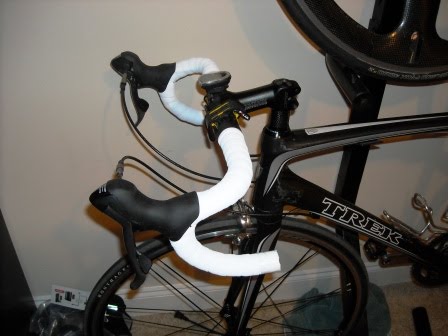
My grip tape was starting to wear in a couple of areas. I bought a roll of grip tape on sale. I’m a little bit behind the times and I am certainly not a pro but I picked the white tape. I mentioned this a couple of weeks ago during a Wednesday Night Ride. One of the guys, Ty asked me if I was going all eighties and if I was going to get my ear pierced again.


Before - plain Jane black grip tape.

I have done this a time or two - remember that, when looking from the left side of the bike that the tape wraps counter clockwise.  Do as I say, not as I do - the above is incorrect.


Still wrong.  Why, because you have a natural tendency to grip the tape and push it forward.  This will prevent the tape from unrolling prematurely.  When doing the right side, stand on the right side of the bike and wrap it clockwise.

I actually like the yin yang / black white look - kind of anyway.


Finished product.  I think it turned out well on a black and white bike.

However, the question is if I will like dingy, dirty white on a black and white bike?

I did not know that the white tape was that retro – but, I am probably not going to get the ear pieced (again?)but I might rock the neon or maybe a Frankie Says shirt – Do you kids even remember those?

Thursday, July 1, 2010

Back to the heavyweight - How to basal metabolic rate PART 3

Okay, so after a few calculations you now know your resting metabolic rate and how to figure out your activity level. You also know how to add in your exercise.  There are many on line calculators to help tabulate how many calories a given activity burns.   If you missed them - PART 1, PART 2

But let’s go back to the easy routine part.

If you remember, with my sedentary activity factored in I burn about 2000 calories a day. I make sure that I get this amount each and every day. However, I am not a calories counter. I am calorie conscious but I have but up routines to help me better cope with my diet.

I like to eat fairly often – I am not talking 10 meals day or anything more like 4 or 5 meals a day. So I break the 2000 calories into meals. I can have five 400 calorie meals or four 500 calorie meals. I used to make little ‘deal-a-meal’ type index cards. Now I just have these meals in my head.

For breakfast I almost always have a big bowl of oatmeal (300 calories) with a huge heaping tablespoon of natural peanut butter (180 calories). For lunch, well it might be a large bowl of homemade black bean soup – it has squash, black beans, sweet potatoes, onions, garlic and jerk Caribbean spices – I call it Jamaican Me Crazy Soup (350 calories) and a hardboiled egg (75 calories). Many times I will have another small bowl of oatmeal with peanut butter for an afternoon snack (250 calories). At dinner I will eat a HUGE salad consisting of spinach, tomatoes, mushrooms, carrots, sugar snap peas, and a grilled chicken breast topped with a couple of tablespoons of low at ranch dressing (about 500 calories for the entire mix). For an after dinner snack it might be a cup of low fat cottage cheese (150 calories), a cup of vanilla almond milk (90 calories) and a half cup of fiber one cereal (60 calories).

Okay, after I typed that out it does not seem so easy but it really is – my meals are modular and they are all around 400 – 500 calories. I have several to choose from and I can mix and match. The grilled chicken I prepare all at once on the weekends. The Jamaican Me Crazy Soup is also prepared in a weekly batch. Everything is always prepared and you just have to throw it together.

So that handles all of my RMR calories; each and every day. But what about the training calories? Well that is taken care of immediately pre and post workout. Most morning I do not get much to eat before hitting the trail. But I add the calories in protein shakes and extra bowls of oatmeal (complex carbohydrates). So let’s look at last Sunday’s first bike ride. It was an hour of intense cycling. I would guess that it was about 600 – 700 calories. When I got back from the ride I had a scoop of protein power (120 calories) and a large bowl of oatmeal (500 calories). I know that I should not have the fat from the peanut butter but my diet is not perfect.

The take home message is to determine the necessary calories to sustain yourself on a daily basis and then break it up into manageable meals. Next add the extra calories for your training.

Try this out of a couple of weeks. If you want to lose weight then cut out a couple hundred calories. Do the opposite to put weight on. This does not take a lot of math or discipline; it only takes building a habit.

Wednesday, June 30, 2010

Back to the heavyweight - How to basal metabolic rate PART 2

So now I know my resting metabolic rate - link to PART I. If you remember, your RMR is basically how many calories you expend just sitting on the couch doing nothing.

However, most of us are doing things during the day other than sitting on the couch. We have to go to work, we have chores, and we get to train. We need to add those calories to the RMR to know how many calories to eat in a given day.


So, for me, I make sure I get my RMR calories and then I add a few more for my activities. Unfortunately I have a sedentary desk job. No matter how hard I type on a keyboard I am not expending very many calories. (On a sidebar I do boost my metabolism by doing a few exercises at my desk and I make sure I always take the stairs!) I am always conscious with my weight so I am conservative. I doing the Activity Factor of sedentary of which is RMR x 1.2. My daily calories for just living are 1670 x 1.2 = 2004 calories. This includes walking around, sitting in the car other mundane tasks.

Next is factoring in your training. You have to add more calories back into your diet for the calories that you expend. A good rule of thumb for running is 100 calories per mile regardless of speed. This actually works out to be fairly accurate. And remember, we do not have to be exact; we just need to be close. Monday was a recovery day after a lot of cycling miles over the weekend. I went for an easy 3 mile run at lunch with a friend. It does not matter how long the run took; it only matters how far – 3 miles. I add those 300 calories to my RMR + activity calories and get 2004 + 300. To maintain my weight I need about 2300 calories yesterday.

That works out pretty good. On a side note, I almost always underestimate calories burned. The machines at the gym, the heart rate monitors and almost all other methods lie – they grossly overestimate. Take a look at the treadmill the next time you are on it – it is very, very hard to burn a 1000 calories an hour.

Also, you must remember that while you were exercising you were actually alive. Your RMR has already counted those calories. For me that is 1670 calories a day which is nearly 70 calories per hour. Since it took about 30 minutes to run those 3 easy miles I have to deduct 35 calories from my 2300 calories. That might not seem like much but I know some of you are doing 3 and 4 hour bike rides and bricks and such. Those 70 calories an hour do start to make a difference.

I know it looks like it is hard to manage but it is just habit. Stay tuned, I will show you how.

Tuesday, June 29, 2010

Back to the heavyweight - How to basal metabolic rate

After my return home from Boston I was scared to set foot on the scale. Lack of exercise and overindulgence on food and drink would nudge the number higher. I have not been following my diet since the Pump and Run. I was a little under weight for that race – for obvious reasons but I rebounded more than I would have liked. Normally I bounce around 159 – 161 pounds. So I got on the scale after the travel and I was 8 pounds over my Pump and Run weight. That is over 5 percent in a month. I weighed 165 pounds which is the most this year!

Last year while training for ironman I dipped down to right around 155 pounds. I think it would be tough for me to get down there again. I have put on some muscle mass (not just from the pump and run) this year.
A full day of calories for many people!

Simply getting back into my routine has allowed for my body to respond and drop some of the weight. I have dropped 3 pounds in 3 days but that was the water weight. The next few pounds will be harder. It is time to get back on the horse and start the food journal back up. If you want to change something you have to know where you are. I actually have a pretty good understanding of where I am but the practice of documenting will get me on the fast track.

For those that do not know where to start, first you need to know your basal metabolic rate or more accurately their resting metabolic rate. This is the amount of calories you need to just live – nothing more. There are two formulas for calculating your BMR or RMR (for our ball park purposes these terms are interchangeable). The standard formulas are the Harris-Benedict and the Muffin. Where w – weight in kg, h – height in cm, and a = age. Let’s run the numbers for me – weight = 161 lbs = 73 kg, height 5’7” = 170 cm, age = 37.

H-B MEN = (13.75 x w) + (5 x h) – (6.73 x a) + 66 = 1670.74 calories

H-B WOMEN = (9.56 x w) + (1.85 x h) – (4.68 x a) + 655 = 1494.22 calories

Muffin MEN = (10 x w) + (6.25 x h) - (5 x a) + 5 = 1612.5 calories

Muffin WOMEN = (10 x w) + (6.25 x h) - (5 x a) – 161 = 1446.5 calories

These are all pretty close. This is the amount of calories you expend sitting on the coach, doing nothing. Next you can multiply the RMR by an activity factor.

Activity Factor Category Definition
1.2   Sedentary Little or no exercise and desk job
1.375 Lightly Active Light exercise or sports 1-3 days a week
1.55  Moderately Active Moderate exercise or sports 3-5 days a week
1.725 Very Active Hard exercise or sports 6-7 days a week4
1.9   Extremely Active Hard daily exercise or sports and physical job

So, for example if I take the RMR from the Harris Benedict calculation and I say that I am Very Active then I get – 1670.74 x 1.725 = 2882 calories per day. A Big Mac, large fries and a large regular soda is 1350 calories. Almost half of you daily allowance (if you are indeed VERY ACTIVE). If you are sedentary then you will only need 2004 calories and this meal is nearly 70% of your daily calories.

There have been numerous studies that indicate that it is not that important for the numbers to be extremely accurate; it is enough to see results if the numbers are just close. This is because the average person has no idea the number of calories in the food that they are consuming. Most people will grossly underestimate the number of calories in their food and then grossly overestimate the number of calories that they expend. They will see results if they can just get close to reality.

I remember a few years ago I was talking with a co-worker that was very overweight. She stopped at Hardee’s on the way to work and picked up a 6 pack of their little hamburgers. I think they called them slammers (I don’t think they make them anymore). I told her that the amount of calories and fat were more than she needed for the entire day much less than for lunch. She looked up the nutritional information on the website and said “See there, they are only about 100 calories each.” I took a look at the website and she was reading the chart incorrectly. They only weighed about 100 grams – not calories. The number of calories for each slammer was 280 calories (6 x 280 = 1680 calories). She still did not believe the numbers and was certain that the website was mistaken. Good figure.

Now if you look at that VERY ACTIVE amount of calories (2882) and try to eat only health, nutrient dense foods you will see that it is a whole heck of a lot of food. Do you know how many raw vegetables that is? How many boiled eggs? How about glasses of almond milk? How many pounds of lean chicken breast? When you eat healthy it is hard to eat enough!

Link to a BMR Calc

Thursday, May 20, 2010

Goal setting - a couple more points

I forgot a couple of other important points to setting goals. These work particularly well for me.

I am a data junky. I measure things. I write things down. Now I usually do not actually go back and run statistics on the data but the act of writing the numbers down keeps me on task. For example, I weigh myself every morning and write it down. I have been doing this for nearly 10 years. I started doing this when my weight was an issue. But, writing it down each morning keeps me honest with my weight. It is a reminder. It also makes it less likely that I will over indulge – I have to step up to the scale the next morning and the number gets recorded. No if ands or buts – the numbers don’t lie (although they can fluctuate wildly).

The act of measuring (and recording) will allow you to make better decisions – like it or not. Want to eat better. Start a food journal. If you are honest and write everything down you will be much less likely to grab a few pieces of candy out of the receptionists jar. It causes you to have personal accountability for your actions.

And speaking of accountability, tell the world of your goals. Lay it all out for your friends and family. The people around you will give you support and they will also let you know when you slip up.

I know so many people that say that they have goals but they keep them to themselves. Why? Keeping their goals hidden just provides an out. Are they afraid of failure or success? Jon Berghoff uses the phrase "Leverage your Integrity." He elaborates, "Public commitment closes the door on backing down, giving up or delaying of a dream."

If my goals are not written down and declared they are just wishes – lottery tickets if you will.

Tuesday, May 18, 2010

SMART goal setting.

Are you meeting your goals?


This is a question that is often on my mind. Hey, wait a minute; I’m getting ahead of myself.


Are you setting goals? Do you know how to set goals? I have found that all my greatest successes were from a calculated plan. Luck very rarely just happens. As the old saying goes, “You make your own luck!” And luck is easier to manufacture when you set goals. I have always had my own ways for setting goals but I ran across this fantastic acronym – SMART.

Specific –

You have heard this before. The goal has to be specific. You cannot say I want to be healthier or faster or wealthier. That won’t cut it. A specific goal will answer the basic questions of: What do you want to achieve? Why do you want to achieve this? How are you going to achieve this?

One other important aspect of the initial goal setting is to ask yourself, “Is this my goal?” You may ultimately have success but it will be much easier (and gratifying) if it is your goal.

Measurable –

The goal must be measurable. This is how you gauge your progress. This is how you know that you are going in the right direction. This can be weight on a scale, inches around your waste or seconds in a foot race. If you are using the goal to establish a new habit then this is paramount – number of time to the gym in a week, fruits and veggies in your diet, miles per week, etc. Count it, measure it, weight it – achieve it!

Attainable –

Many goals seem unobtainable. However, almost all goals can be achieved if you break them up into steps. These small “progressive goals” will allow you to have success. And these successes will keep you motivated.

I use the term comfortably hard all the time. For me this is an effort that is challenging but not drop-dead difficult. I think that this is the sweet spot on many things – training, goals, etc. If the effort is too difficult you will give up – if not today then soon. It is not a question of will power, discipline or determination.

Losing two pounds a week is better than saying a need to lose 100 pounds now. You are not instantly going to drop 10 inches off of your waist but maybe an inch or two this month is achievable. You are not going to go from the couch to a Boston BQ by this weekend.

Success builds on success.

Realistic –

Your goals need to be just out of reach. If they are too close then they are not a challenge and do not have the necessary value to motivate. On the other hand, they must be realistic – we are talking about goals not dreams and fantasies. None of us are going to the Olympics (except as spectators) and none of us are going to have the fitness magazine (read – airbrushed) beach bodies.

How do you run a sub-18 minute 5k? First you run an 18:15 and then work really, really hard. Be realistic.

Timely –

You must have a time frame of your goals. Without a since of urgency the goal will not have priority. You will think that you can miss this workout or eat that piece of cake. After all you have forever …

Putting these steps into practice and you will achieve your goals – it is just a matter of time.
powermultisport
Fitness Anywhere: Make your body your machine.