Ironman 101 has moved to a new domain. Now Bigger, Better, Faster, Stronger!

Please click here to continue reading - Power Multisport.
Showing posts with label review. Show all posts

Tuesday, July 13, 2010

New diet - Flat Belly Diet for Men

I went to the library last week and picked up a few diet books. I love looking through these types of books. I also enjoy self help books. I have read so many of them. Most are garbage but a few have very good advice. I have even read self help books about self help books – no joke. I started a blog a couple of years ago where I was going to do a ‘New Year’s’ resolution each month for a year. I think I got about four months into it before the ironman training started to consume too much time.

Anyway, I ran across this diet book called the ‘Flat belly diet for men.’ It is a follow-up to the same book for women. There are also a couple of recipe books in this series.
Flat Belly Diet! for Men
The premise is pretty close to what I already do – multiple small meals throughout the day. This book has a four day kick start plan. In the kick start phase you have four 400 calorie meals a day. After this phase you start the normal diet which is five 400 hundred calorie meals a day.

Like I said, this is close to what I already follow. The difference is the meals themselves. The book is big on MUFA’s (mono unsaturated fatty acids) – pronounced MOOFAS. Every meal needs to have these good fats. In my normal routine I already follow this to an extent. For a very long time I have been eating oatmeal with peanut butter. Healthy carbohydrates and MUFA’s. However, I have become dependent on that one meal. When I am hungry this is the meal that I grab. There have been days when I have had this one meal four or five times. I am fortunate that I can eat the same things day in and day out but I do need variety. This is where the book is going to help me. There are about 50 different balanced meals that have approximately 400 calories.

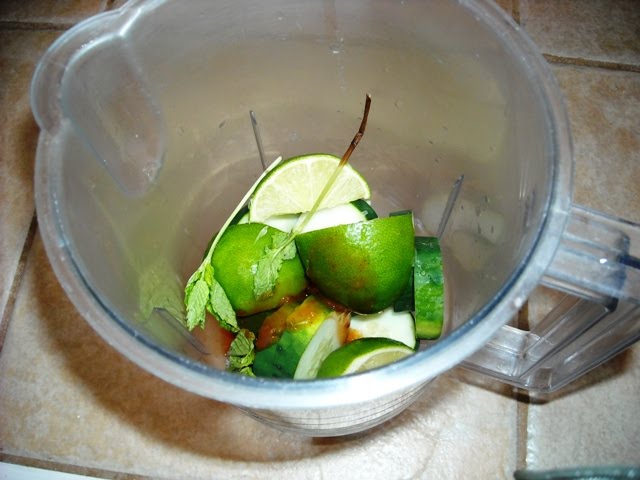
There is also this drink concoction called ‘fire water’. It consists of the following:

½ teaspoon grated fresh ginger
1 small cucumber
1 lime
6 mint leaves
3 -4 dashes shot sauce

It does not taste bad. In fact it is a little bit refreshing - it smells like a fancy lotion from bath and body works or something. I am, however, not sure if you are supposed to drink all of the chunkiness. I filtered it through a coffee filter the next day.

With the recipes in the book I am going to make up my own deal-a-meal cards and mix and match. I will keep you posted on the results. Also, since the book does not require exercise I will continue with what I have always done – add a few post exercise meals into the mix. Otherwise I get into this deep calorie deficit and consume everything in sight.

I will keep you posted on the results of the diet!

Monday, May 10, 2010

Shower Poufs and water bottles

The other day a friend asked me about something on my bike. I do not run some super exotic tricked out triathlon bike – not by the standards of those who upgrade every year. I do have a triathlon bike that is a couple of years old and it does have an aero frame and an aero seat post and all of that stuff. But in the transition area it barely gets noticed. So when someone says “Hey James what is that on your bike?” I take notice. The next question was “Is that a shower pouf?”

You see, although it is definitely old technology, I still ride with a first generation profile design front mounted aero bottle (I’m going to refer to this as simply the bottle from now on). These things have gotten more bad reviews than I can count. Everyone hates these bottles. They hate the mounting mechanism (rubber bands), they hate the yellow spongy thingy, they hate the lack of a lid and they even hate the non-aero straw. But you still see hundreds of the dang things at every race (as evidenced by all of the yellow spongy thingies at the first big bump).

Profile Design Aero AWater Bottle

I don’t have any of these issues. It should not be this way but I have adapted to the bottle – it has not adapted to me. First, the yellow spongy thing does not go in as a vertical cylinder. Some people roll them into a donut shape and others wedge them into the bottle horizontally. Both of these methods work well. If you do stick the yellow spongy thingy in the bottle opening vertically it WILL bounce out when you hit any rough pavement. You have seen the yellow sponge graveyards at almost every race – unless of course you were leading. I doubt Andy Potts or Macca have witnesses this but I have seen it. I bet there were 300 of these in the rough pavement of 70.3 New Orleans this year (rough pavement plus starting in the second to the last wave).

I must admit that the large rubber bands are not the best solution to mounting the bottle. The bottle will fit in between most aero bars so the rubber bands are only used to keep the bottle from jostling. However, these rubber bands become brittle after a few months. After a race last year I went to pick up my bike and the rubber bands had split. The bottle hit the ground. Not the best solution. Profile design sells a bracket that is mounted to your aero bars. This bracket is used if your aero bars are too wide to hold the bottle. The bracket is supplied with a thin piece of hook and loop fastener that should hold the bottle in place. However, threading this hook and loop fastener into the bracket is very cumbersome.

So although my aero bars are definitely narrow enough I use the bracket. This raises the bottle up a little bit higher. Instead of the hook and loop fastener I use a piece of nylon strapping with a snap closure like you would find on a luggage strap. I just had one lying around but a shoe string or any other type of cord would work. Now that I think about it a piece of elastic from a set of Yankz! Would work great (I know you can buy shock cord by the foot from places like REI). I also put a couple of pieces of electrical tape around the bottle where it slides into the bracket. There are no squeaks from the bottle.


Mounting bracket with strap

Next is the splash guard. This is where the shower pouf comes into play. These are perfect replacements for the yellow spongy thingy. They actually do a much better job. The plastic mesh of the pouf is of a finer weave and really traps the liquids so that they do not splash. The shower poufs only cost about a dollar and you can get them in any color that you would like – I have a red one that coordinates with my bike! I get very little splash with my shower pouf in place.

I dispose of these at the end of every season. You see, I used to do the aquarium thing a few years ago. And one of the old techs back then was to use materials that had a huge surface area to ‘grow’ bacteria. This bacterium is used to process waste materials in the aquarium.

Red color matched shower pouf

Why am I telling you this? Well, these shower poufs are perfect if you want to culture large amounts of bacteria. And there is probably no better place than a warm sugary environment – like in the bottle mounted to the front of your bike. Yeah, if you do not clean this bottle and shower pouf after every couple of ride then you will start to see cultures. Yuck!

Now, I am lucky in that I do not drink sugary drinks when I ride. I prefer to get my calories from gels. And if I do carry sugary water while on the bike I will stick it on the down tube water bottle.

Now onto the non-aero straw. You see, there have been wind tunnel tests that show that a cylinder is one of the most non-aero shapes. On message boards, it is discussed at length on how non-aero the straw is. It is said that the straw acts like a flat piece steel the size of a piece of typing paper turned against the wind. This information can from DC Rainmaker’s blog – which by the way, I am a HUGE fan of this blog! This is based on the assumption that the straw is 12 inches long and a third of an inch wide. With my bracket and such I have cut my straw down to less than 5 inches (don’t judge me).

5 inch straw

Now this aerodynamic information came out of a wind tunnel and I am in no means implying that I am an aerodynamics genius, but I would think the non-aero straw is the least of my worries. If I can find a straw shaped like an airfoil I will try it out.

So, why have I made all of these adaptations to use this bottle? It certainly does seem like many trials and tribulations to just use a water bottle. Well, the simple fact is with the water bottle up front I tend to drink twice as much. Really! I have looked at my water consumption on my road bike (no water bottle up front) and I drink a 20 ounce bottle in 20 miles. With my triathlon bike I tend to over hydrate. It is not uncommon for me to look down and all of my water is gone in a little over an hour (the aero bottle and the down tube mounted bottle). I try not to over hydrate but I would much rather have the water in me then left on my bike when I exit transition.

Wednesday, April 14, 2010

REVIEW: Innovations CO2 inflators

Since I had a flat last weekend I thought that I would give a short review of a couple of CO2 inflators. On my old road bike I always carried a frae pump. My old road bike was aluminum and had a traditional geometry. The frame pump was spring loaded and would fit under the top tube. My current road bike is made of carbon and the geometry is compact. My frame pump does not fit on this road bike. Furthermore, the frame pump does not fit my triathlon bike either.

Ultraflate PRO

So I made the switch to using disposable CO2 cartridges. I like to think of myself as being very green. In addition, I do not like to use items that are disposable due to cost. Since I ride primarily on a rails to trails I do not encounter the road side hazards that I would if I were on regular streets. I am going to jinx myself but looking back I have had an average of three flats a year. Considering that I ride over well over 5000 miles a year that is an acceptable cost to me.
Ultraflate PRO with cylinder

The first inflator that I us is an Innovations Ultraflate PRO. I have had this inflator for several years (in fact I could not find this particular model on the Innovations website – it may be discontinued). I like this inflator for a couple of reasons.

PROS

1. It is small
2. It is light (55 grams)
3. It is easy to use

CONS

1. Will not fit HED3 carbon wheels
This inflator has a cylinder that you can put a CO2 cartridge in and then tighten the cylinder to puncture the cartridge. This allows for the use of threadless cartridges. Although the cylinder is designed for use with only 16 gram cartridges you can put paper in the bottom of the cylinder to take up excess space. This will allow you to use even cheaper 12 gram threadless cartridges. You can also ditch the cylinder and thread a cartridge onto the inflator head.

Ultraflate PRO- 55 grams

And as I have said, this inflator is easy to use. The inflator head acts much like a floor pump head. You screw the CO2 cartridge unto the inflator head. Next, you push the inflator on the tube stem and pull the metal lever out. The inflator is now locked on to the valve stem. There is a small red button under the metal lever. This is used to regulate the amount of CO2 injected into the tube. Once complete you simply push the metal lever back to the original position while pulling the inflator from the stem. This inflator has served me well. However, it will not fit my race wheels.

Microflate Nano

So now I carry an Innovations Microflate Nano CO2 inflator for my triathlon bike (well most of the time I carry it – last weekend was the exception). I selected this inflator for a number of reasons.

PROS

1. It is very small (this is one of very few inflators that can be used on HED3 wheels)
2. It is very light weight (23 grams – that is less than a gel)
3. It is easy to use (although not as easy as the Ultraflate PRO)

CONS

1. Must use threaded cartridges
Let me elaborate on each of these points. My race wheels are HED3 carbon wheels. These were designed before long valve stemmed tubes and have a molded cut out area. This area only allows a small pump head to fit. Many CO2 inflators, and floor pumps for that matter, will not fit into the recessed area of the wheel. My older inflator, the Ultraflate PRO, will just not work with my race wheels.

I also like the small physical size and weight of the Nano inflator. I have mounted this inflator a number of places on my race bike. I have used Velcro to attach the inflator and a CO2 cartridge under my aero bar pads, stuck them in the tiny back pocket of my unitard and stuck them in a small camera bag that I have zip tied to the back of my seat. A larger inflator just would not have worked in all of these situations.

Microflate Nano - on a normal wheel

Now onto the easy of use. The inflator does take two hands. Make sure that the valve is open on the tube stem. With this particular inflator you screw the CO2 cartridge all the way onto the inflator head. Then you have to press the inflator nozzle onto the valve stem. While press down hard, – I like to wrap my hand around the entire wheel and hold the inflator tight to the stem, slowly unscrew the CO2 cartridge. This will allow the CO2 to enter the tube. Do not let the nozzle lose contact with the valve stem. If you do lose contact with the stem then CO2 gas will be released into the atmosphere and not into the tube. You saw Chrissie at Kona right?

Microflate Nano - on a HED3

With the small size and design of the inflator there is one huge drawback. You must use threaded CO2 cartridges. This may not seem like a big deal but it is the reason that I do not carry this inflator on my road bike or most training rides. Threaded CO2 cartridges are many times more expensive than the threadless cartridges (like $4 or $5 each). You have to buy the threaded cartridges at bike stores while the threadless cartridges can be purchased in large discount stores in the air rifle section (sporting goods). Last year I bought several dozen 16 gram threadless cartridges on clearance at an office supple store. They were deeply discounted.

Microflate Nano - 23 grams

In conclusion both of these inflators get the job done. The Ultraflate PRO is easier and cheaper to operate. It is almost fool proof and if I am using 12 gram threadless cartridges then it cost about 30 cents per cartridge. The Microflate Nano is more versatile. I can use it on all of my wheels but at a much greater cost.

When it all comes down to it I really do not care how much I have to pay to keep me from walking miles in my cycling shoes!

Tuesday, April 6, 2010

REVIEW: Ryders Eyewear Tangent Sunglasses

I received a set of Ryders Eyewear Tangent sunglasses in the mail on Thursday. I won these from KC over at 140.6 Miles . KC is an extraordinary athlete (she rode over 12,000 miles last year). She has also done the Boston Marathon many, many times and is training for her first iron distance triathlon. In addition to a great blog she has almost replaced my Pandora radio account with her play lists. We happen to be about the same age so we have similar tastes in music. I’m listening to some beat heavy techno while I type this …

Anyway, back to the sunglasses. I was shipped the Tangent sunglasses by Ryders Eyewear. I do not see this particular pair on their website but I did find the pair on several overstock type internet retailers. I think that these Tangent sunglasses are the same as the current Hijacks. What I was not aware of is that both of these sunglasses (the Tangents and Hijacks) can be purchased with 3 sets of interchangeable lenses – instructions for taking the lenses are located here. Taking these lenses out is by far the easiest interchange lens sunglasses that I have ever had. I have been wearing a set of cycling sunglasses from Nashbar that came with gray, clear and amber lenses but I never take the amber lenses out. It is just not worth the effort required. I am always afraid that I will snap the lenses in half while taking them out or putting them back.

So I had Good Friday off of work and I wanted to get some riding in – the day was beautiful. Now I am a glasses wearer and I only wear contacts when I exercise. And by exercise I mean something longer than an hour or two. So I put my contacts in and suited up for a 50 mile bike ride at moderate intensity. The sunglasses have adjustable nose pieces that can be moved in and out and back and forth. I am sure that the nose pieces are a flexible wire that is covered in a thick pliable rubber. In fact, this rubber coating is said to become tacky when wet (like from sweat and stuff). The sunglasses fit my face right out of the box and needed no adjustment what so ever. I can not comment on how often the nose pieces could be adjusted before their elasticity gives out – but this adjustment should be a set it and forget it type adjustment.

On the bike -

I headed out towards Bassfield. The sunglasses fit my face well. I have had troubles with fit with a lot of glasses, both corrective vision and sunglasses. Many times they will sit too close to my face and my eyelashes with brush the inside of the lens. These sunglasses sit a comfortable distance from my eyes. They also do not rest on my check bones. Looking straight ahead they fill about 90 percent of my vision. I can only see around the glasses if I make an effort to look straight up. Then I can see above the glasses. While riding in the aero bars, on the tri bike, this is more pronounced. Riding the race bike my head is tilted down more. I would guess that instead of my head being parallel to the ground my head is rotated down about 10 degrees. This allows me to see over the top of the glasses easily when I look up the road. I actually do not find this distracting my others may not like the unobstructed view between the top of the sunglasses and the bottom of the helmet. I have not worn the sunglasses with my race helmet which fits tighter to my face and my road helmet. I will have to try this out before my next race (two weeks until 70.3 New Orleans).

As I said earlier I only wear my contacts when doing exercise. I always wear them during triathlons – I can’t see very well during the swim portion without my glasses. One of the reasons that I do not wear my contacts all of the time is that my eyes are very sensitive wind and dryness. When wearing contacts, even if it is dark I will be wearing amber or clear lenses. If my eyes start to dry out it is very uncomfortable and distracting. I experienced no discomfort while wearing these sunglasses. That is saying a lot. There is a fine line between the sunglasses sitting too close to my face and not allowing too much air to circulate between the lens and my eyes. My eyes were not dry and there was no fogging. I was surprised at how well the glasses worked on the bike.

On the run -

When I finished the 50 miles I immediately ditched my cycling shoes and put my running shoes on. I shelved the helmet and put a running visor on. I am trying to transition over to ‘summer feet’ so I did not both with socks. My body temperature was up and I wanted to put in a good effort after the bike. This was just as much for mental toughness as physical toughness. I put my self in difficult positions so that I have to step it up and overcome – therefore I am not always successful. I had a good bike but I need to continue to succeed. I headed out the door with only a change of shoes – the transition was only about a minute.

To make a long story short, I finished up the 5 mile ‘hard’ brick at a pace faster than I thought I could run. What can I say about the sunglasses during the run? When I am running hard I tend to notice things – this is something that I am working on. Not wearing socks I immediately noticed that I do not have ‘summer feet’ right now. I am soft from the winter. I developed two small blistered – one on each foot in the same place. I noticed that my hamstrings were feeling better while running at effort this week – much better than last week.

But what about the sunglasses? I got nothing – nada – period. There was not that annoying bouncing up and down where you have to tuck the ends of the sunglasses into your hat to calm them down. There was not a noticed gap between visor and sunglasses. There was no fogging or trapped stream forming on the inside of the glasses. The sunglasses just worked. Nothing more report.

Style –

I would not have picked the olive green if I could have selected from the entire Ryders line-up. But that would have been picking from pictures on the internet. After I got them I actually like the olive green. It is not an army green color like I thought is was going to be but more of a translucent green. In fact you can see the sunlight illuminating the rims of the sunglasses. I like the look. However, if I were to choose from the entire line I probably would have picked the BRIGHT orange Hijacks. I like the flashy colors.

DISCLAIMER: Although this product was given to me I was not asked to write any kind of review. I have simply provided my honest opinion of the product. Please take my experience with the product at face value. Your mileage may vary.

Friday, March 5, 2010

Mardi Gras Rock 'N' Roll Marathon Race Review

About the race. The EXPO was well run. It was crowed but that was to be expected. However, the Competitor Group has refined this process. It took all of 2 or 3 minutes to get processed. This was the largest race that I have ever participated in and this was the most efficient check in! When I did my ironman it literally took hours. Yes, there was a lot of hand holding for the ironman and regulations and rules and stuff but there were only 3,000 people participating – the marathon had 16,000. The Rock ‘n’ Roll Series has this down to a science.


The EXPO itself was pretty good also. There were several booths doing what appeared to be brisk business. You were also able to show your ID so that you could have beer at the finish line. If you checked in during the EXPO you would not have to show ID at the finish line. You could also sample the MGD 64 in Dixie cups at the EXPO. But, there was a rumor that you were only allowed 2 beers at the finish. That must be a dirty joke – this is after all New Orleans. The New Orleans Track Club almost starts serving beer prior to the start of their races. Now, don’t get me started on Baton Rouge – many races have food and drink the night before the race (included in the fee) as well as food and beer immediately following the race. This two beer limit must be a joke.

The race started near the convention center. The corrals were well marked and each corral had several port-a-loos. This was done very well. When I first got to the start line there were no lines for the potties and I hopped in and did my business. A little bit later I needed to go again and this time there was a line but it was acceptable. Even with a line it took only a couple of minutes. I don’t know how many corrals there were – twenty something I would guess – and there were a couple or three port-a-loos in each corral. I appreciated the amount of facilities that were available. There was a VIP area near the start that had heaters so you could stay warm. This area also had food, drinks and VIP bathrooms. However, you had to have purchased $150 worth of stuff at the EPXO. That was not for me.

The start was in the warehouse district, an industrial part of town. I have started at races here before and it is as good as anywhere to start. The course went east and looped around Audubon Park. This was a nice run even though the pavement was less than ideal. After the race I heard several stories of people falling. I hate to hear that but this is New Orleans and the roads are just that bad – there is no way around that.

Prior to the race I was looking over the course map and I was immediately concerned about the Half and Full marathoners branching off from each other and then merging back. I was concerned because the two groups would merge back together at mile 4.5 for the half marathoners and mile 8 for the full marathoners. I was afraid that there would be two groups of runners at very different paces. Worrying was all for not. The groups never actually merged – instead they ran side by side separated by a median or a line of cones.

As the name of the race suggests, there were a lot of bands. They were place at every mile of the race. This was not as motivating as you might think. You ran by the bands and heard them for about a minute. I do not remember any of the bands specifically. Maybe the bands are for the spectators?

The volunteers were plentiful and enthusiastic. There were cheerleaders from area schools everywhere cheering the runners on – they were competing for monies for their schools. Water and sports drink was every mile. I prefer to take gels and wash them down with straight water. It might be prissy but I do not want to spill the sports drink all over me and have to lose the mental concentration fussing with the stickiness. Anyway, I always take my own gels so this is not an issue for me (my gels are looped into my race belt), but I believe that there were only two water stops that had the gels. The map of the race indicated that gels would be available but it did not say where they would be available. If I had not had my own gels I might have been out of luck. As it turns out I did take 3 gels from the course. I combined this with the 5 that I had with me. Yes, that is right, I had 8 gels during the race (1 before and 7 during). Not having gels at all or most water stops seemed, I don’t know, I guess a little bit cheap. Once again, this did not pose a problem for me.

The finish line was lined deep with spectators and you could see the clock from a hundred yards out. This was well done and it definitely encouraged me to ‘sprint it out’. Once you crossed the finish line you were given your medal and a sports drink. The area immediately after finishing was well stocked with bagels, bananas, sports bars, water and sports drink. You were also given a solar blanket. There were speakers at the exit of this area that told you that once you left you would not be allowed back into the area. The notification system was well done. There was no doubt that you would not be let back in – they also had security standing there to ensure that no one came back into the area. I was spent when I finished and did not feel like eating much of anything – after all I had just finished a marathon. I did eat a bite of a banana and grabbed an additional sports drink as well as two sports bars.

I left the finishers area and found my group. I changed clothes in a port-a-loo. The park was huge and you had to walk a good distance to the reunion area. They had letters posted in a field that allowed for you to easily meet up with group. I thought this was done well. We ventured over to the letter P (for Pine belt Pacers – our running club) and met several of our group. The ground was damp so we used our solar blankets to keep us dry.

I went over to the beer area and my race bib procured me two beer tickets. They marked the bib to show that I had received my tickets. Each additional beer would be $2. Now, this race cost well over $100. I wonder how much money was saved (or made) from limiting cans of cheap beer? This did not affect me too much but there was a lot of grumbling amongst the finishers. In addition, who carries money with them on a race? I guess you could have packed it in your finish line bag – but …

After a few more people finished we started to get a little bit hungry. There was no food available outside of the finisher’s area. I take that back, they did have food for purchase. Now here is the rub, they have a captive audience of 16,000 people that have just run several hours and they charge them for food. That is just wrong. I have been to a lot of races and there is always food for the racers. That is just how races are done. There was a national chain restaurant serving food for free if you jumped through some hoops the day before. I was not aware of this and I did not jump through the necessary hoops. Anyway, they ran out of food.

This was also a point to point race and you had to take shuttles back to ‘near’ the start. There was no parking at the finish. You had to walk about a mile to get to the shuttles. I am not sure why they could not have been closer. I mean, we did have to walk along a road to get to the buses. But the number of buses was plentiful. There was no wait once you made the trek. The buses took you to the Superdome which is where most of participates had parked for the race and the second stop was close to the French Quarter. But if you were staying in a hotel near the race start you had another mile to walk. I knew where the shuttles were dropping off and was okay with the walk but I did hear of many people being upset – especially if you did not know the area.

I am aware that you cannot make everyone happy. And I did have a great race (I am signed up for next year already – I signed up prior to running the race for about a 50% discount). But there are a few things that need to be done better. Having done a number of triathlons I often hear of people being upset with WTC (World Triathlon Corporation - the ironman company) and talk about how expensive their races are. Both of these companies put on an efficient race and sell an experience. And I am perfectly fine paying for these experiences. At the end of my ironman, there was a ton of food (cheap food like pizza, bagels, cookies – but who cares at the end of an ironman) and even complimentary massages. My ironman and my marathon were both wonderful. But the Rock ‘n’ Roll marathon series seems to be rather greedy. After all, it is just a marathon. If you charge a premium you had better deliver. With just a few changes to the amenities these events would be spectacular. I believe that the cost of the race should cover post race food. For crying out loud, no one would have complained if they charged an extra $5 and gave you a hamburger (although the race is already at a premium). There are a lot of marathons around. I am not sure if the Rock ‘n’ Roll experience is the premium.

The Good:
Fast easy check-in
Nice EXPO
Start Line facilities
Nice course
Volunteers
Ample water stations
Festive Finish line

The Bad:
Expensive Race
No FOOD
Limited Beer
Limited Gels at the water stations

All in all I had a great race and many of the CONS just did not have an effect on my experience. Most of what I am reporting on was from other racers. However, I do see their points. As I have previously mentioned I will be doing the race again next year. It will be interesting to see how the race grows.
powermultisport
Fitness Anywhere: Make your body your machine.